
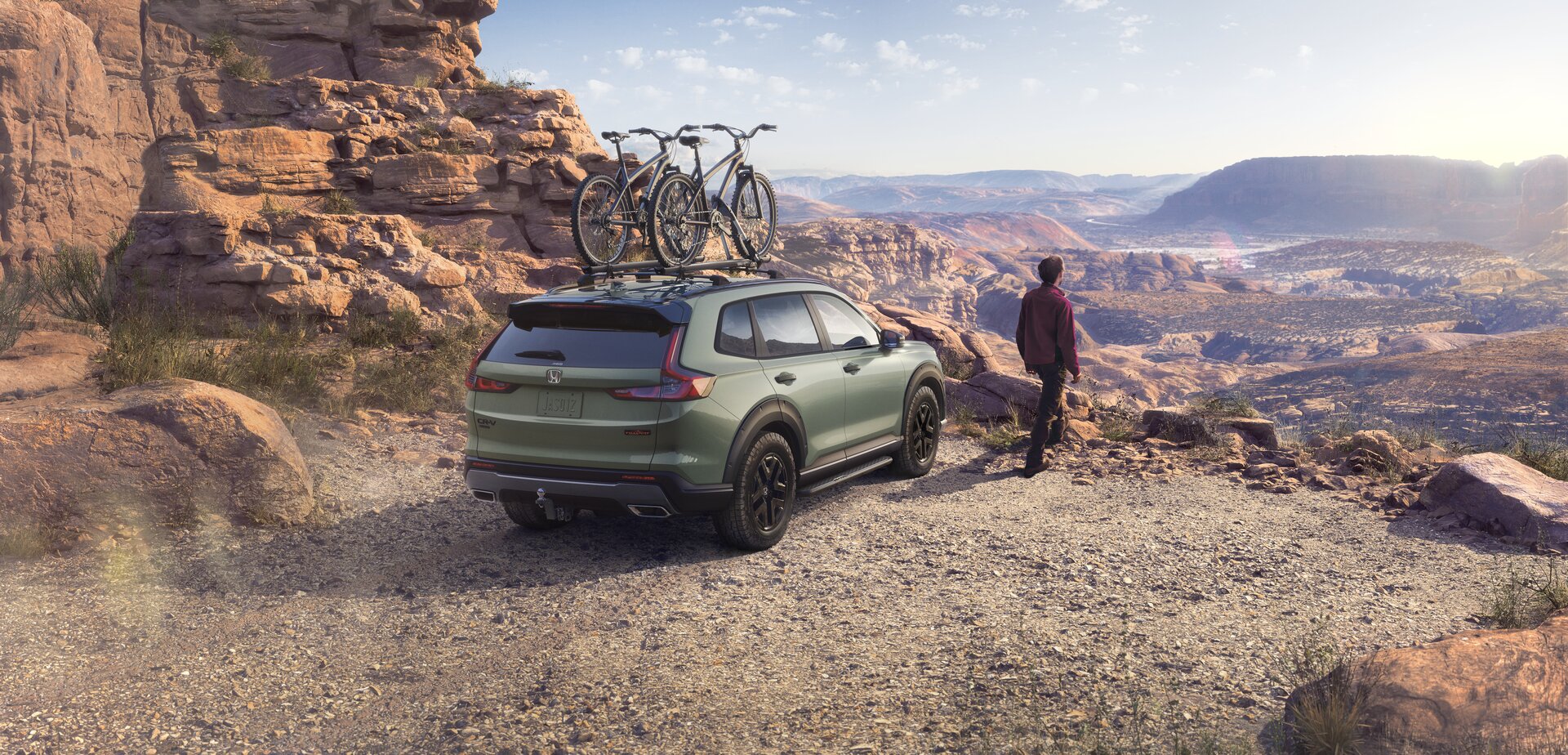
The Rancho Santa Margarita context
South County families don't just need a "good crossover." You need something that fits two car seats with a stroller in the back, runs the carpool to RSM Intermediate without burning through gas, behaves on a long 5 South slog to San Diego, and doesn't feel out of place at the Plaza El Paseo farmer's market. Both the CR-V and the RAV4 can do all of that, but they do it differently.
Specs at a glance (2025)
| Honda CR-V EX | Toyota RAV4 XLE | |
|---|---|---|
| Engine | 1.5L turbo, 190 hp | 2.5L NA, 203 hp |
| EPA combined MPG | 30 mpg | 30 mpg |
| Hybrid available | Yes (~40 mpg combined) | Yes (~39 mpg combined) |
| Cargo behind 2nd row | 39.3 cu ft | 37.6 cu ft |
| AWD option | Real-Time AWD | Dynamic Torque AWD |
| Honda Sensing / Toyota Safety Sense | Standard | Standard |
| Typical OC EX-trim transaction | Low-to-mid $30s | Low-to-mid $30s |
How each one drives in OC
The CR-V feels notably more refined on Antonio Parkway and on the 241 toll road. It rides quieter at 75 mph, the steering is more linear, and the cabin doesn't drone the way the naturally-aspirated RAV4 can when you bury the throttle on an on-ramp. The RAV4 feels more upright and trucky, that's part of its appeal for some buyers, but it's the first thing you notice after a back-to-back test drive.
On the freeway grind that defines a lot of South OC weekday driving, the CR-V's CVT and 1.5L turbo combo is genuinely smooth. The RAV4's 8-speed automatic is fine but shifts more noticeably under load. For a parent making the same drive five times a week, that adds up.
Family fit: car seats, strollers, and Costco
Both fit two rear-facing car seats without forcing the front passenger into the dash, which isn't a given in this segment. The CR-V has a noticeably wider rear opening, easier to load a sleeping toddler. Cargo behind the second row is a bit better in the CR-V (39.3 vs 37.6 cu ft), and the load floor is lower, which matters every time you lift a stroller or a Costco-sized box of paper towels.
Hybrid math for a typical RSM family
Most South County families we hear from drive 12,000–18,000 miles a year. At that mileage, the CR-V Hybrid (~40 mpg combined) saves roughly $400–$700 per year in gas vs the turbo gas model at current OC prices. The hybrid premium is typically $2,500–$3,500, so payback is around 4–7 years, well within how long most local owners keep a CR-V. The RAV4 Hybrid math works out very similarly.
Pros and cons
Honda CR-V
Pros
- ✓ Smoother, quieter ride on 5 / 241 freeway commutes
- ✓ More cargo and a lower load floor
- ✓ Hybrid feels especially refined in stop-and-go
- ✓ Local availability is strong at RSM Honda
Cons
- - Towing capacity is modest (1,500 lb gas, 1,000 lb hybrid)
- - Top trims push into mid-$40s
Toyota RAV4
Pros
- ✓ More rugged styling, appeals to buyers who like the trucky look
- ✓ Slightly higher max tow (1,750 lb on most trims, 3,500 lb on TRD / Prime)
- ✓ Strong long-term resale
Cons
- - Louder cabin at freeway speed
- - Naturally-aspirated 2.5L feels strained merging onto the 5
- - Cargo opening is narrower
Which one for Rancho Santa Margarita?
For most local families, daily school runs, freeway commuting, weekend trips that don't involve real off-roading or boat towing, the CR-V is the more comfortable, quieter, more refined choice, especially in hybrid form. The RAV4 earns its spot if you want a more rugged-looking SUV, you tow more than 1,500 lb, or you're already deep in the Toyota service ecosystem.
The CR-V Hybrid EX-L is the trim most South County families end up genuinely happy with: comfortable, quiet, efficient, and well-equipped without pushing into "loaded SUV" pricing.
RSM Honda · Rancho Santa Margarita
See current CR-V inventory and offers at RSM Honda
Browse live inventory, current incentives, and lease specials directly on the official RSM Honda site.